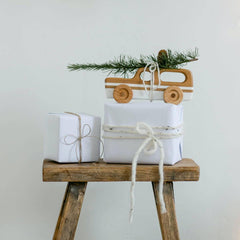

A wooden car never tells a child where it is going.
One morning it might be carrying a family to the seaside. By afternoon it is racing across a cushion mountain, rescuing a bear or making an important delivery beneath the kitchen table. The toy stays the same; the story belongs entirely to the child.
This is the quiet magic of open-ended play. There are no fixed instructions, no single correct result and no flashing button waiting to supply the next idea. A child is free to imagine, build, experiment, change direction and begin all over again.
In this guide, we explore what open-ended play means, why it matters and how thoughtfully chosen toys can make room for years of changing stories.

What is open-ended play?
Open-ended play is play without a predetermined ending. Instead of following a set sequence or working towards one correct answer, children decide what an object is, what happens next and when the game is finished.
A handful of wooden blocks might become a tower, a road, a zoo, a birthday cake or the walls of an imaginary village. A cardboard box can be a boat before lunch and a puppet theatre after it. Because the play is led by the child, the same materials can be returned to again and again in completely different ways.
You may also hear it described as child-led play, free play, imaginative play or unstructured play. The terms are not identical in every setting, but they share the same lovely idea: the child contributes more than the toy.
What makes a toy open-ended?
An open-ended toy does not need to be complicated. In fact, the simplest toys often leave the greatest space for imagination. Look for playthings that:
- Can be used in more than one way.
- Do not depend on one correct answer or finished result.
- Invite children to build, arrange, move, sort, pretend or tell stories.
- Work happily alongside other toys and everyday materials.
- Remain interesting as a child’s skills and ideas change.
Open-ended does not mean that every toy must be completely plain, nor does it make puzzles, games and other structured toys less worthwhile. Children benefit from many kinds of play. The difference is simply that an open-ended toy leaves the direction and outcome in their hands.
The benefits of open-ended play
When a child makes up the rules, play becomes full of small decisions. Which block will balance? How can the bridge reach the other side? Who lives in the house? What happens when the tower falls? These ordinary moments support a surprisingly rich collection of skills.
Creativity and imagination
Open-ended toys provide a starting point without supplying the whole story. Children create their own characters, worlds and possibilities, learning that one object—or one idea—can become many different things.
Problem-solving and flexible thinking
A wobbly tower or a road that will not quite join is not a failure; it is an invitation to try something else. Children can test an idea, notice what happens and adjust their plans without an adult stepping in with the answer.
Language and storytelling
Small-world and pretend play are naturally full of conversation. Children narrate events, give voices to characters, explain their creations and negotiate roles with other players. A simple scene can gather a whole vocabulary around it.
Social and emotional development
When children build or pretend together, they practise listening, sharing ideas, taking turns and finding their way through disagreements. Imaginative play can also give them a safe space to explore familiar events and feelings in their own time.
Fine motor skills and spatial awareness
Stacking, balancing, turning, posting and arranging all ask small hands to work with care. As children build, they begin to understand shape, size, distance, balance and the way objects relate to one another.
Confidence and independence
There is no model to copy and no wrong finished answer. The child is the inventor, builder and storyteller. Seeing their own ideas take shape helps them trust their judgement and enjoy the process rather than waiting for approval.
For more about play that grows from a child’s own ideas, read our guides to constructive play and encouraging independent play in toddlers.
The best types of open-ended toys
The best open-ended toys are not necessarily the biggest sets or the ones with the longest list of features. They are the pieces children reach for when they have an idea of their own.
1. Wooden blocks and building toys
Blocks are perhaps the classic open-ended toy. They can be stacked, lined up, counted, sorted, used as scenery or combined with cars, dolls and animals. A toddler may enjoy filling and emptying a basket of blocks; an older child may use the same set to build a detailed city.

If blocks are already a favourite in your home, discover 14 creative ways to play with wooden building blocks.
2. Small-world toys and play houses
A simple house, a few figures and some found objects can become an entire world. Children might recreate family life, invent new characters or turn the building into a shop, school, animal hospital or woodland hideaway.
Small-world toys are especially lovely when they are not too prescriptive. An open structure and simple figures allow children to decide who lives there and what sort of day they are having.

3. Simple vehicles
Cars, trains and other vehicles give a story movement. They can follow a wooden track, travel along a road drawn on paper or weave around chair legs on their way to an imaginary destination.
A simple vehicle with freely moving wheels asks the child to supply the sound effects, passengers, route and reason for the journey. It is a small toy with a wonderfully large number of possibilities.
4. Stacking, balancing and loose parts
Rings, arches, animal stackers and collections of loose pieces can be balanced, sorted, ordered and transformed. A stacking toy does not have to be assembled in the same arrangement every time; its pieces can become fences, stepping stones, food for a pretend café or furniture in a small world.

5. Nature finds and creative materials
Not every open-ended resource needs to begin in a toy box. Leaves, shells, pebbles, fabric scraps, cardboard tubes, paper and clay all invite children to arrange, collect, create and wonder.
Nature play changes with the seasons. A flower press can hold the results of a spring walk, begin a botanical journal or supply real petals for cards, collages and framed pictures. The gathering is part of the play, and the finished flower carries the memory of where it was found.

How to choose an open-ended toy
There is no single list of open-ended toys that suits every child. Begin with the person in front of you: what do they already notice, collect, build or pretend?
Follow their interests
A child who watches every passing vehicle may return to a wooden car for years. A nature-lover might prefer a flower press or set of botanical blocks. A child drawn to storytelling may lose themselves in a house, dolls or puppets.
Choose possibility over novelty
Ask how many different kinds of play the toy might invite. Can it join things they already own? Can it be enjoyed quietly alone and woven into a larger game with others? Will it still have something to offer when their imagination becomes more complex?
Keep age and safety in mind
Always follow the maker’s age guidance, particularly where small parts, magnets, cords or heavy pieces are involved. For babies and younger toddlers, choose larger pieces that are comfortable to grasp and suitable for their stage of development.
Look for materials made to last
Open-ended toys are handled often and used in all sorts of unexpected ways. Solid construction, safe finishes and repairable, durable materials matter. A well-made wooden toy can gather the marks of real play and remain ready for younger siblings, cousins and another generation of stories.
Remember that less can offer more
A room full of toys can make it difficult to settle into any one idea. A smaller, thoughtfully chosen collection displayed within reach often gives children more space to notice what they have and use it deeply.
How to encourage open-ended play at home
You do not need a perfect playroom. A corner of the sitting room, a low shelf or a basket that comes out at the kitchen table is enough.
- Make toys visible and reachable. A few inviting pieces are easier to choose than a deep box filled to the top.
- Rotate rather than continually add. Put some toys away and bring them back later. Familiar pieces can feel new when they return.
- Mix toys with ordinary materials. A scarf becomes a river; a cardboard box becomes a garage; stones become food for a wooden animal.
- Allow unhurried time. Deep play rarely begins on command. Children need time to wander through ideas and recover from the occasional declaration of boredom.
- Let the child lead. Resist the urge to show the “right” way. Their tower does not need to look like yours.
- Ask questions that leave room. Try “Tell me about what you’re making” or “What might happen next?” rather than guessing what the creation is.
Open-ended play ideas by age
Open-ended play changes as children grow. The toy may remain familiar while the way it is used becomes richer.
Babies and young toddlers
At this stage, open-ended play is often sensory and physical: grasping, rolling, posting, filling, emptying, stacking and knocking down. Choose safe, generously sized pieces and allow plenty of repetition. The pleasure may be in doing the same thing twenty times—and learning something slightly different each time.
Older toddlers and preschoolers
Stories begin to bloom. Blocks become homes, vehicles carry passengers and dolls develop elaborate routines. Offer simple props, art materials, stacking toys and small-world pieces, then follow the unexpected direction their play takes.
School-age children
Older children may create complex structures, games with their own rules, detailed miniature worlds, performances or long-running projects. Open-ended play does not have an expiry date; it simply grows alongside their knowledge, humour and imagination.
The role of grown-ups in child-led play
Sometimes the most helpful thing an adult can do is make the space, offer the materials and quietly step back. Watch before joining. A pause does not always need filling, and a small problem does not always need solving.
When you are invited in, accept the role you are given—even if you have been appointed the dragon, the passenger or the customer ordering a rather unusual lunch. Shared imaginative play can be wonderfully connecting, but the child should still feel that the story belongs to them.
Open-ended play questions
What is an example of open-ended play?
A child building with wooden blocks is a simple example. There is no required model or finish: the blocks may become a tower, an animal enclosure, a road or something known only to the builder.
What is the difference between open-ended and closed-ended toys?
An open-ended toy can be used in many ways and has no single outcome. A closed-ended toy or activity usually has a defined goal, such as completing a jigsaw or matching shapes to their correct holes. Both can be valuable; they simply invite different kinds of thinking.
Are open-ended toys suitable for toddlers?
Yes. Open-ended toys for toddlers include age-appropriate blocks, stacking toys, simple vehicles, dolls and sensory materials. Check the manufacturer’s guidance and avoid pieces that are too small for the child’s age.
Do open-ended toys need instructions?
Usually very little instruction is needed. A safety explanation or brief introduction may help, but the purpose is to allow the child to discover possibilities rather than reproduce an adult’s example.
How many open-ended toys does a child need?
There is no magic number. A small collection of versatile toys, combined with household and natural materials, can inspire a great deal of play. Quality, accessibility and time matter more than quantity.
Leave the ending open
The most memorable toys do not always perform the most tricks. Often, they are the quiet ones waiting on the shelf: a car ready for a new road, a block waiting to become part of something larger, or a small house with no story until a child arrives.
Choose toys that leave something for them to imagine. Give the play time to unfold. Then watch as an ordinary object becomes a world you could never have planned for them.