
In a world filled with blinking screens and plastic playthings, there is a growing movement of parents and educators who are turning to traditional wooden toys to provide a simpler and more imaginative play experience for children. These timeless playthings, crafted from natural materials like wood, offer a refreshing departure from the noise and constant stimulation of electronic gadgets.
Traditional wooden toys provide endless possibilities for open-ended play, allowing children to use their imagination and creativity to explore and learn. From simple building blocks to wooden cars and dolls, these toys can become part of a new story every time they are picked up.
With their tactile appeal and warmth, wooden toys engage the senses and offer a kind of play that feels unhurried. There are no flashing instructions to follow and no single ending to reach. The child decides what happens next.
So, if you are looking for a way to introduce simplicity and imagination into your child’s playtime, consider rediscovering the charm of traditional wooden toys. Let their imagination take flight and watch as they embark on countless adventures, building a foundation of creativity that will last a lifetime.
Why simpler toys leave more room for imagination
Wooden toys have a certain allure that is hard to resist. Their simplicity and timeless design evoke a sense of nostalgia and charm. Unlike toys with flashing lights, loud noises and a set sequence of responses, wooden toys rely on the child’s imagination to bring them to life. Whether it is a wooden train set or a collection of building blocks, these toys provide a blank canvas for children to create their own stories and scenarios.
A simple toy does not tell a child what it is thinking. A wooden doll may be sleepy, brave, cross, kind or setting off on an expedition; a car may be making the journey to nursery, crossing a make-believe desert or carrying acorns home from the garden. The same toy can be part of a completely different world tomorrow.
The tactile nature of wooden toys also adds to their appeal. The smooth texture of the wood, the weight of the toy in the hand, and the natural variations in colour and grain all contribute to a sensory experience that is both calming and engaging. Children are drawn to the warmth and authenticity of wooden toys, which cannot be replicated by a screen.
The charm of traditional wooden toys lies in their ability to spark the imagination. Instead of dictating how they should be used, they allow children to take the lead. They can become anything their imagination desires—a spaceship, a castle or a forest full of animals. The possibilities are endless, and the only limit is the child’s own creativity.

What imaginative play looks like
Imaginative play rarely needs to look elaborate from the outside. It may be a child murmuring to two little figures at the edge of a rug, lining up cars beneath a chair, or turning a handful of blocks into a house. The real play is taking place in the ideas, characters and relationships the child is creating.
With open-ended wooden toys, there are no rules or right answers. Children are free to experiment, change direction, make mistakes and begin again. A tower can fall and become a bridge. A stacking toy can become a family. A pull-along animal can be a companion on a journey from the kitchen to the moon.
This freedom matters because children are not simply following a script written for them. They are making decisions: who lives here, what went wrong, what happens next and how the story will end. Sometimes they play alone, absorbed in a world of their own making; sometimes another child joins in and the story has to stretch to hold two sets of ideas.
There is room for adults too, but we do not always need to lead. An open question—“Where is the car going?” or “Who lives in this house?”—can open a door without deciding what is on the other side. Then we can step back and let the child take us there.
Why open-ended, imaginative play matters
Play is not just a way for children to pass the time—it is an essential aspect of their development. Through play, children learn about the world around them, develop important skills and make sense of their experiences.
In a fast-paced and highly stimulating world, it is valuable to give children opportunities for open-ended play that encourages simplicity and imagination. Traditional wooden toys are ideally suited to this purpose. They allow children to engage in unstructured play driven by their own interests, without needing to complete a level or wait for the next instruction.
Simplicity can foster creativity because a toy with fewer prescribed functions leaves more decisions to the child. As children build, arrange, move, pretend and begin again, their play can support several areas at once:
- Imagination and storytelling. A blank canvas gives children space to invent characters, settings and their own unfolding narratives.
- Problem-solving. Building a structure, balancing pieces or finding a way across an imaginary river encourages children to test ideas and adapt them.
- Language and social play. Pretend worlds give children reasons to describe, negotiate, listen and decide what happens together.
- Fine motor practice. Stacking, positioning and moving wooden pieces asks for careful hand-eye coordination and control.
- Focus and independence. When children choose the direction of play, they can stay with an idea, explore it fully and develop confidence in their own decisions.
Unstructured play also allows children to explore their own ideas and interests, developing a sense of autonomy and self-direction. Curiosity, resilience and a willingness to try again are not delivered by the toy; they grow through what the child chooses to do with it.

How to create space for simpler, more imaginative play
In a world where technology is an integral part of daily life, it may seem challenging to incorporate traditional wooden toys into modern playtime. However, with a little creativity and intention, it is possible to make room for the digital and the traditional. This is not about creating a perfect playroom or removing every screen. It is simply about leaving some quiet space in the day for a child’s own ideas.
- Rotate toys. Instead of overwhelming your child with a large number of toys, put out a smaller collection and rotate it regularly. This can make familiar toys feel fresh again and encourages children to explore each one more fully.
- Create an inviting play area. A low shelf, a basket beside the sofa or a clear patch of floor can be enough. Keep a few open-ended toys within reach so children can begin without needing an adult to set everything up.
- Combine toys with other materials. Wooden toys can be paired with fabric scraps, cardboard tubes, a scarf, paper, stones or pinecones to create even more possibilities. A piece of cloth may become a river, a roof, a picnic blanket or a cape.
- Let different toys meet. A wooden car does not have to stay with other vehicles. It can visit a block-built town, collect a doll, deliver pretend food or carry tiny woodland treasures. Mixing pieces makes the play less prescriptive.
- Take play outdoors. When the maker’s instructions allow, carry a few suitable toys into the garden or park. New surroundings bring new stories—a path becomes a road, a tree root becomes a mountain and fallen leaves become supper for a wooden animal.
- Resist the urge to demonstrate every possibility. Show a child what is needed for safe use, then leave room for discovery. Their idea may look nothing like yours, which is precisely the point.
If independent play is new, begin gently. Sit nearby while doing something quiet of your own, offer a simple starting idea if it is needed, and allow the story to grow without correcting it. Our guide to encouraging independent play in toddlers has more practical ideas for building that confidence over time.

Simple wooden toys that can become almost anything
The best imaginative play toys are not necessarily the most complicated. Often, it is the familiar shapes and uncomplicated pieces that return to the playroom year after year.
- Building blocks may become towers, beds, bridges, food, telephones or an entire town. Their play value changes as a child’s ideas and skills grow. You can explore more of the benefits of wooden blocks in our separate guide.
- Wooden cars, trains and tractors invite movement, sound effects, journeys and small-world stories. A few blocks or lengths of ribbon are all that is needed to make roads and destinations.
- Wooden dolls and figures can be anyone. Their simpler expressions leave space for children to decide how a character feels and what their story might be.
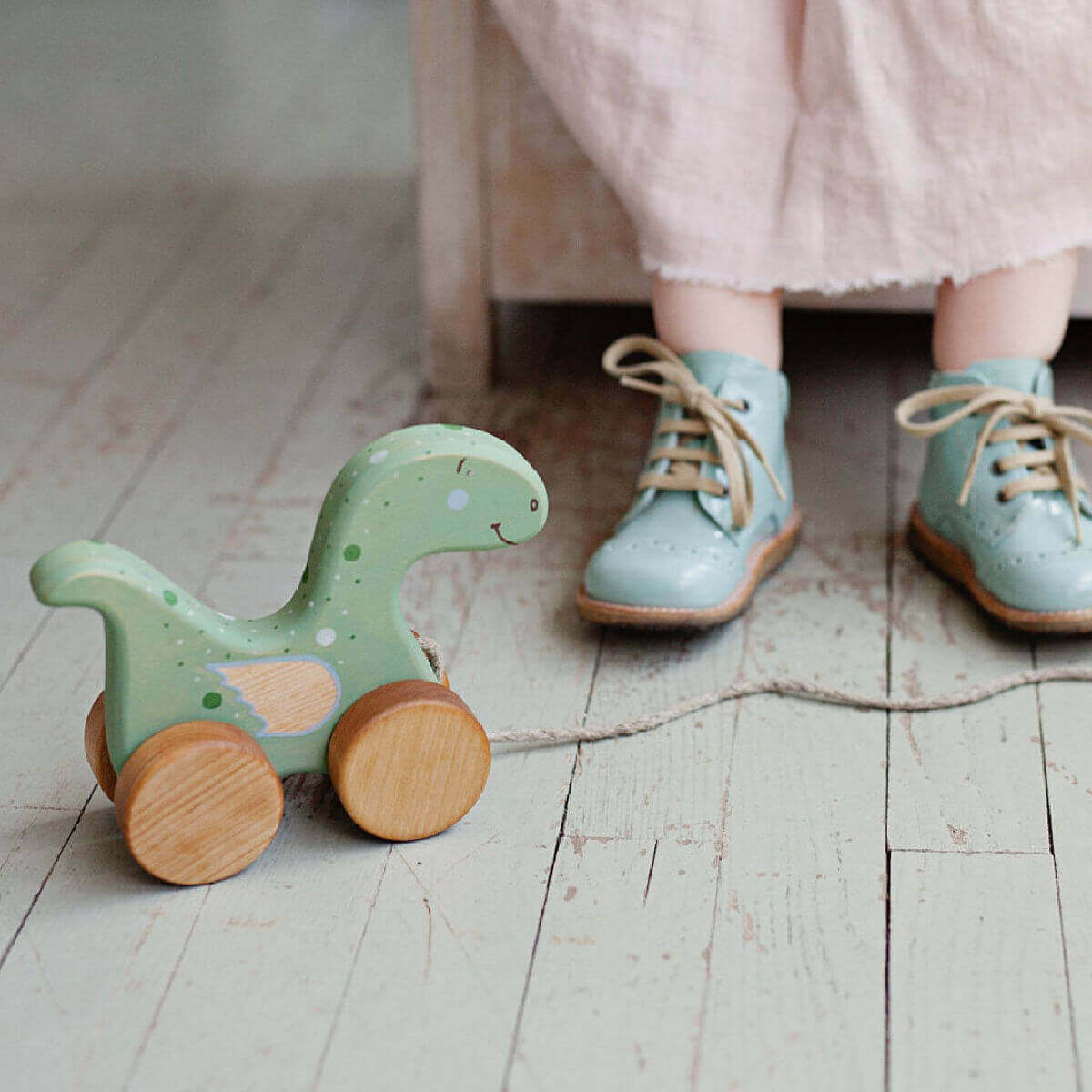
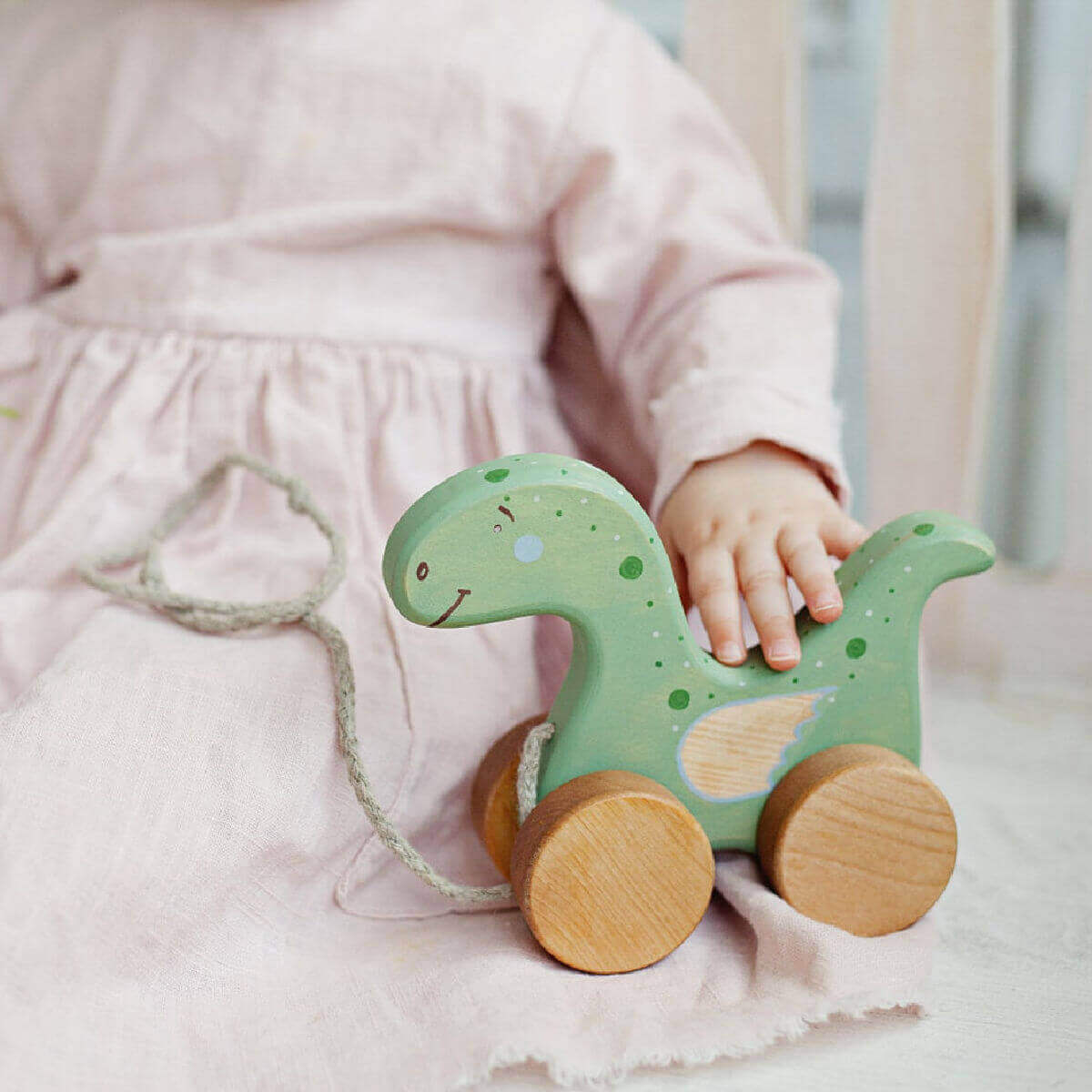
- Push-and-pull toys bring whole-body movement into pretend play and can become companions as children travel through the worlds they invent.
- Stackers and simple puzzles may begin as a satisfying hands-on challenge, then wander into imaginative play as towers, people, animals or scenery.
- Role-play toys inspired by kitchens, gardens and workshops let children revisit everyday experiences, try out grown-up roles and transform familiar routines through make-believe.
There does not need to be a huge collection. A few pieces that work well together can create more possibilities than a crowded toy box of single-purpose toys. When the same object can take on ten different roles, there is always another story waiting inside it.

A quieter kind of play, not a ban on technology
Simpler play does not have to mean rejecting modern life. Screens can entertain, connect and teach; traditional toys offer something different alongside them. They give children a physical world they can move, rearrange and control with their own hands, at their own pace.
There is no score to chase and no correct ending. A story may pause for lunch and continue later, or be dismantled and forgotten the moment it is complete. The value is in the making: the private conversations, surprising ideas and small problems solved along the way.
For a broader look at the materials, longevity and enduring appeal of wooden playthings, read The Timeless Appeal of Traditional Wooden Toys. This guide has a different purpose: to celebrate the spaciousness of simple play and the imagination a child brings to it.
Rediscovering simplicity and imagination
There is an undeniable charm to traditional wooden toys that is hard to put into words. Perhaps it is the simplicity of their design, the natural beauty of the wood, or the way they evoke memories of a quieter time. Regardless, there is something magical about these playthings that captivates both children and adults alike.
They remind us that children do not need every detail supplied before play can begin. Sometimes a smooth wooden figure, a little car or a handful of blocks is enough. The child supplies the voices, the landscape, the danger, the rescue and the way home.
So, if you are looking to introduce simplicity and imagination into your child’s playtime, consider rediscovering the charm of traditional wooden toys. Let their imagination take flight and watch as they embark on countless adventures—each one made entirely their own.